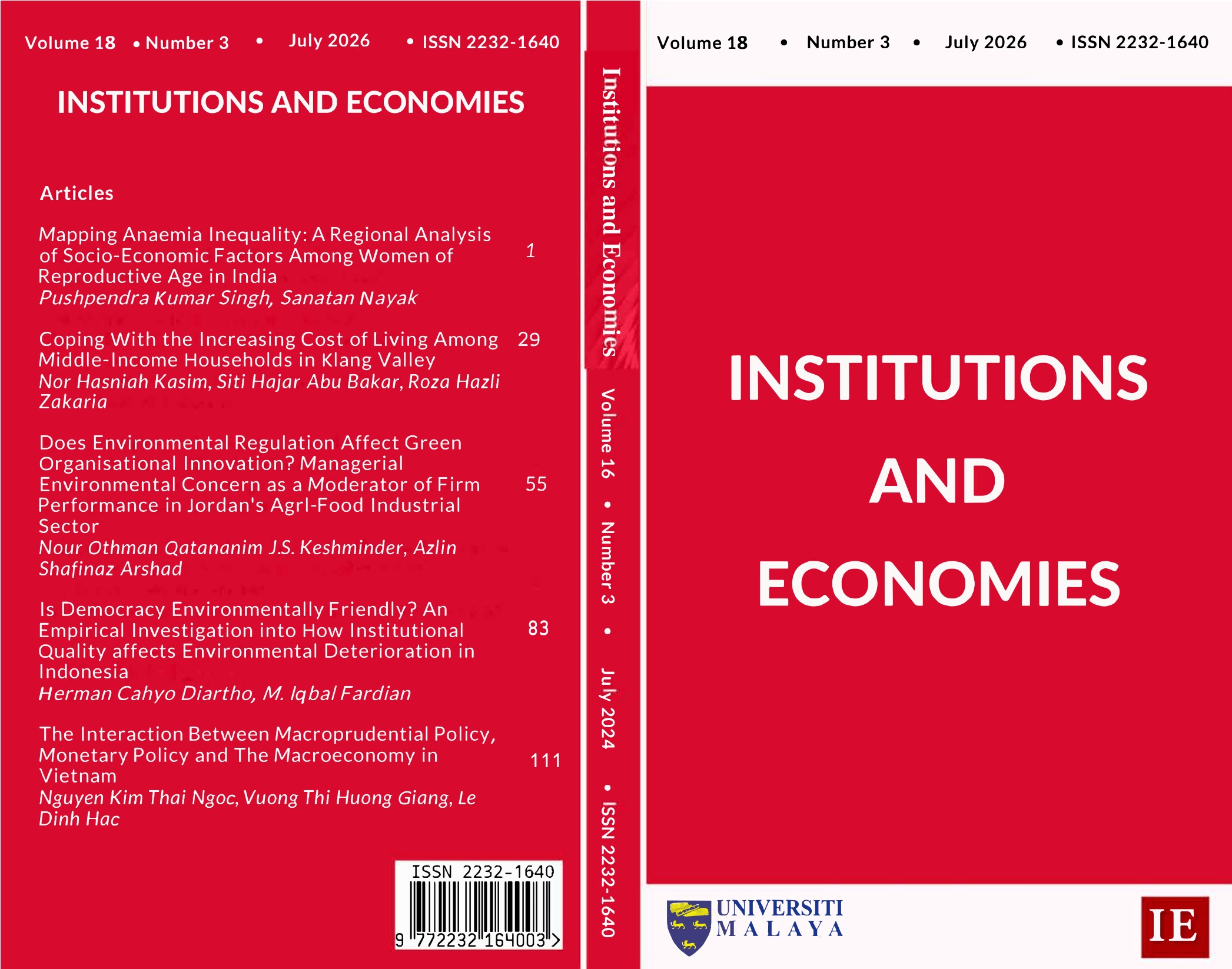
Coping With the Increasing Cost of Living Among Middle-Income Households in Klang Valley
DOI:
https://doi.org/10.22452/JIE.vol18no3.2Keywords:
Cost of living, Middle-income households, Household economics, Coping strategies, Behavioural copingAbstract
The increasing cost of living poses significant financial challenges, leading
to stress and anxiety and prompting the employment of coping strategies. While many
studies focus on low-income groups, middle-income households are increasingly affected
by the cost of living, as it impacts their stability and well-being. Understanding their
coping strategies is crucial, as their economic participation is vital in sustaining economic
growth. This study examines coping strategies employed by urban middle-income
households in the Klang Valley to manage rising living costs, utilising a qualitative case
study approach. In-depth interviews were conducted to explore their experiences and
responses to economic challenges. The thematic analysis reveals three primary coping
strategies: asset-based, behaviour-based, and assistance-based strategies. Asset-based
strategies include selling assets, using savings, delaying payments, and utilising credit
facilities. Behaviour-based strategies involve lifestyle modifications, such as reducing
leisure expenditure, adjusting consumption, prioritising essentials like education, and
taking on extra jobs. Assistance-based strategies include seeking financial and social
support from family, friends, and institutions. The study underscores that middle-income
households face significant financial pressures, often adopting strategies similar to those
of low-income groups. These highlight the need for policymakers to address the challenges
by expanding financial support mechanisms. Recognising the critical role of the middleincome
group in economic development is essential to balanced growth and reducing the
impact of rising living costs.
Downloads
Published
Issue
Section
License
Submission of a manuscript implies: that the work described is original, has not been published before (except in the form of an abstract or as part of a published lecture, review, or thesis); that is not under consideration for publication elsewhere; that its publication has been approved by all co-authors, if any, as well as tacitly or explicitly by the responsible authorities at the institution where the work was carried out. Transfer of copyright to the University of Malaya becomes effective if and when the article is accepted for publication. The copyright covers the exclusive right to reproduce and distribute the article, including reprints, translations, photographic reproductions, microform, electronic form (offline and online) or other reproductions of similar nature.
An author may self-archive the English language version of his/her article on his/her own website and his/her institutions repository; however he/she may not use the publishers PDF version which is posted on www.ijie.um.edu.my. Furthermore, the author may only post his/her version, provided acknowledgement is given to the original source of publication and a link must be accompanied by the following text: The original publication is available at www.ijie.um.edu.my.
All articles published in this journal are protected by copyright, which covers the exclusive rights to reproduce and redistribute the article (e.g. as offprint), as well as all translation rights. No material published in this journal may be reproduced photographically or stored on microfilm, in electronic database, video disks, etc., without first obtaining written permission from the publishers. The use of general descriptive names, trade names, trademarks, etc., in this publication, even if not specifically identified, does not imply that these names are not protected by the relevant laws and regulations.
The copyright owners consent does not include copying for general distribution, promotion, new works, or resale. In these cases, specific written permission must first be obtained from the publishers.